Saturday, March 07, 2009

18 Ambassadress in Brussels


The «Association Femmes d’Europe» in Brussels has published a book titled book "18 Ambassadrices vous reçoivent à Bruxelles".
In this book eighteen Ambassadress in Brussels virtually open the doors to their residences and share some unusual anecdotes about the history of these exceptional buildings. They reveal the intimacy of the Embassies and talk about their lives as wives of diplomats. From the Gala dinner to the informal luncheon with friends, the Ambassadress take the reader by the hand through the backstage of their receptions: décor, tables, menus and details on their personal recipes from around the world.
The volume presents eighteen of the most prestigious Embassies in Brussels such as France, Italy, Switzerland, Spain, Argentina, Brazil, Egypt, Unites States, Indonesia, Spain, Korea, Monaco and many others. It is fully illustrated with insight pictures by Eric Stinglhamber,
Of the 5 000 copies printed, more than 3 000 were sold on a subscription basis prior to publication. This project, like all other projects of the non-profit organization, is aimed at raising funds for those in need in Europe and the Third World.

Bibliographic Reference:
Association Femmes d’Europe, 18 Ambassadrices vous reçoivent à Bruxelles, Editions Laconti, Bruxelles, 2008, pp. 190 (ISBN 9782870080412)

Friday, December 05, 2008

Diari di Manlio Brosio a Washington


Manlio Brosio (Torino, 10 luglio 1897-14 marzo 1980) ricoprì la carica di ambasciatore italiano negli Stati Uniti dal 1955 al 1961: oltre sei anni nei quali tenne un diario delle proprie giornate dense di impegni, incontri, impressioni e giudizi. Le sue pagine raccontano una stagione intensa da un punto di osservazione privilegiato. Uno sguardo in filigrana dalla capitale statunitense che permette di inserire le vicende italiane nel vivo del passaggio tra guerra fredda e distensione: la ricerca di uno spazio possibile per l'Italia costretta tra marginalità e ingerenza straniera, tra il rischio di rimanere esclusa dai circuiti decisionali e il pericolo di diventare terra di conquista per la superpotenza di riferimento.

Il volume di Washington dà inizio alla pubblicazione dei diari che Manlio Brosio ebbe l'abitudine di redigere nel corso della sua lunga e brillante carriera diplomatica: ambasciatore italiano a Mosca (1947-1951), Londra (1952-1954), Washington (1955-1961), Parigi (1961-1964) e segretario generale della NATO (1964-1971). Il piano generale dell'opera prevede l'edizione in quattro volumi di un'ampia selezione delle migliaia di pagine manoscritte.

Monday, November 03, 2008

Jacques Rial's Book on Publications of Swiss diplomats


Jacques Rial, a retired Swiss diplomat, has published (in French) the book titled "Le Bicorne et la Plume: Les publications de diplomates suisses de 1848 à nos jours", which contains all data concerning publications of Swiss diplomats since 1848.

It is an extensive research that the author has conducted consulting catalogues of the main Swiss libraries and that has led to some surprising discoveries. For each author, Rial has provided a short biography of each author and the list of publications (both books and short essays). The book covers the editorial activities of 233 Swiss diplomats, with around 2000 bibliographical entries.

This book is included in the series "Diplomats as writers" by Diplofoundation. The first book has been "Through the Diplomatic Looking Glass", by S. Baldi and P. Baldocci, concerning books written by Italian diplomats.
Similar research has now been announced in other countries, especially in Latin America.

Jacques Rial was born in 1932 and Graduated in Literature in Geneva. From 1962-1967 he was a member of the UN Civil Operation in Congo. Rial enters the Swiss diplomacy in 1967 as head of Information in the Development Cooperation.
Secretary General of the Swiss Commission for UNESCO (1970-76). He has served in London and in The Hague. Ambassador in Yaoundé (1983), Montevideo (1988) and Zagreb (1992). Ambassador in charge for migration issues in Berne (1993).


Jacques Rial, Le Bicorne et la Plume: Les publications de diplomates suisses de 1848 à nos jours. (preface by Bénédict de Tscharner)
2008, Graduate Institute of International and Development Studies and DiploFoundation
Paperback, 240 pages. ISBN: 978-99932-53-19-8
Price: 20 Euros

For more information or to order this publication you can visit the Diplo Publications website:
(http://www.diplomacy.edu/Publications/display.asp?Topic=Books/LeBicorne)

Friday, October 31, 2008

Politica e diplomazia in Italia tra XIX e XX secolo. Vita di Antonino di San Giuliano (1952-1914)


dal sito dell'editore:

Antonino di San Giuliano è in fondo un personaggio poco noto in Italia. Gli stessi storici hanno dedicato relativamente poche attenzioni alla vita e all’attività di questo statista siciliano.
Del resto, si è ritenuto che San Giuliano sia stato il mero esecutore di una politica estera voluta da altri: il re Vittorio Emanuele III e i diversi presidenti del Consiglio che si avvicendarono alla guida del paese all’inizio del Novecento, in particolare Giolitti. In realtà, pur restando nell’alveo di direttrici ben collaudate di politica estera, San Giuliano si assunse l’onere di importanti decisioni e dettò i tempi, anche a Giolitti, di rilevanti azioni: si pensi alla guerra di Libia. Fu poi San Giuliano che gettò le basi fondamentali del Patto di Londra, ovvero dello strumento diplomatico che conteneva le modalità secondo cui l’Italia sarebbe dovuta entrare nella prima guerra mondiale per uscirne da grande potenza. Egli lasciò a Salandra e Sonnino lo schema di un Patto che, a suo giudizio, avrebbe dovuto tendere però non tanto ad assicurare all’Italia vasti territori fuori dei suoi confini geografici, quanto piuttosto a darle la sicurezza di condurre una guerra la meno gravosa possibile. Questa biografia si propone dunque di far riscoprire a studiosi e appassionati di storia un personaggio complesso, che mosse i suoi primi passi nella politica locale a Catania, durante la seconda metà dell’Ottocento,e terminò la sua non lunga vita alla guida del ministero degli Esteri, quando l’Italia era tutta concentrata a sciogliere il dilemma se restare neutrale o intervenire nella Grande Guerra.

(2007) pp. 1016

ISBN: 978-88-498-1697-6

€. 45,00

Thursday, August 28, 2008

"Turkey decoded" by the Swedish diplomat Ann Dismorr


The Swedish diplomat Ann Dismorr has published an interesting book titled “Turkey Decoded” (Saqi Books, 2008, pp. 184). She was the Swedish Ambassador to Turkey from 2001 to 2005. In this period the prospect of EU membership helped Turkish governments to achieve substantial democratic reforms which led to the start of accession negotiations with Brussels in October 2005. In her book she examines the implications of Turkey's affiliation with Europe and its role in the Middle East against the broader concerns of the widening gap between the West and the Muslim world, terrorism, and the struggle for human rights and democratization.
The concluding sentences of the book seem to summarize its main argument: "President [Abdullah] Gül and the AK Party government face a historic challenge to demonstrate that Islam and democracy are compatible. Turkey has come a long way in proving that.… The EU is facing a historic choice of how to deal with Turkey -- the most liberal and well-developed democracy in the Muslim world of 1.2 billion people. The world is watching."

Ambassador Ann Dismorr is Head of the International Department of the Swedish Parliament. She has served as a diplomat with the Swedish Ministry for Foreign Affairs for over 25 years. She was Ambassador of Sweden to Turkey from 2001-2005. She has also lived in Saudi Arabia and served as Ambassador of Sweden to Lebanon and Azerbaijan.
She was Private Secretary to the Swedish Foreign Minister in 1992-3 during the final stages of Sweden's EU accession.
From 1995-9 she was human rights expert at the Swedish mission to the UN.
She has an academic background in political science from Stockholm University, Gothenburg University and Yale University.

Tuesday, August 12, 2008

Gharekhan and "The Horseshoe Table"


Chinmaya Gharekhan, former Permanent Representative of India to the UN is the author of the book 'The Horseshoe Table: An Inside View of the UN Security Council' (Pearson Longman, 2006, pp. 328). The book provides an inside view of the functioning of the United Nations Security Council which is a vital instrument at the service of the international community but over which the same international community has hardly any control. In this unique, unprecedented and intimate account, Chinmaya Gharekhan takes the reader through the meetings of the Security Council as it debated such issues as emergency situations during the first Gulf War; Iraq's WMD programme and the work of the special commission set up to eliminate them; the beginnings of the Oil-for-Food programme; the Balkan War of the early 1990s; the Rwanda Genocide, and the Lockerbie disaster involving Libya.

Chinmaya Gharekhan is a former Indian diplomat who served in Egypt, the Congo, Laos, Vietnam, and former Yugoslavia. He has has been posted several times to the Permanent Mission of India to the United Nations. Later as Permanent Representative to the United Nations Office and the Specialised Agencies in Geneva, and lastly as India's Ambassador/Permanent Representative to the United Nations in New York for over six years.

Saturday, July 26, 2008

Book on Diplomacy as teamwork. Italy's experience with Amb. Fulci.

There is probably only one book which contains contributions of 13 diplomats from the same country. It is the Italian book “Italy at the UN. 1993-1999. The years with Paolo Fulci. Diplomacy as a teamwork” (Rubbettino Editore, 2007), available only in Italian and edited by Ranieri Tallarigo (another Italian diplomat).
All the authors have been working with Ambassador Francesco Paolo Fulci while he was the Permanent Representative at the United Nations in New York. The five years described in the book have been very important for Italian diplomacy.
The contributions in the book, full of anecdotes and events, constitute an insider view of multilateral work. Multilateral diplomacy, like other diplomacies, is not an exact science. Nevertheless there are models and best practices that can be developed on the basis of experience. But an important element for success is leadership: from the writings of his collaborators it is clear that Ambassador Fulci was a leader who clearly indicated not only the objectives, but also the methods to achieve them.
Most of the collaborators of Ambassador Fulci are now Italian Ambassadors and it is most probable that they are still putting into practice all the teachings that they received during the Fulci’s years in New York.
The book could be considered a kind of handbook on leadership, teamwork and diplomacy based on a concrete experience in a multilateral diplomatic mission.

TALLARIGO, Ranieri (editor). L' Italia all'ONU 1993-1999. Gli anni con Paolo Fulci: quando la diplomazia fa gioco di squadra [Italy at the UN 1993-1999. The Years with Paolo Fulci. Diplomacy as a Teamwork], Rubbettino, Soveria Mannelli (Cz), 2007, pp. 112. (available at http://www.ibs.it)

Friday, April 11, 2008

Adrian de Hoog: Canadian diplomat and writer


Adrian de Hoog, former Canadian diplomat with a thirty year career, has written two books: The Berlin Assignment (2006) and Borderless Deceit (2007).

His Novels

It is the turbulent Berlin of the early 1990s which provides the backdrop for de Hoog's first novel, The Berlin Assignment. It is a tale of political intrigue: not long after the fall of the Berlin Wall, with a new order in full swing, Canada’s new consul Anthony Hanbury arrives to assume his diplomatic duties. He quickly develops contacts, makes friends, and rises in Berlin society. But is his progress as innocent as it seems? Cold War spies still active in the city assemble a dossier, and the suspicions which accumulate soon threaten to destroy the consul.

Adrian de Hoog’s second novel, Borderless Deceit, is more international still. The intrigue spills effortlessly across borders; individual privacy is in short supply. A virus destroys the communication network of the Canadian diplomatic service. Implicated in the investigation are Carson Pryce, a reclusive, moody intelligence analyst, and Rachel Dunn, a brilliant diplomat with a glowing humanitarian track record. Carson for years has been secretly obsessed with Rachel and abuses his privileged access to intelligence information to keep track of Rachel and people around her. He knows things about Rachel which she doesn’t herself. The investigation into the virus deepens and Carson initiates a cover-up to prevent damage to Rachel’s reputation. As events begin to spiral out of control, both are suddenly forced to go into hiding. After separate, roundabout journeys they end up in an isolated villa in Costa Rica.

Adrian de Hoog was born in the Netherlands but he emigrated with his family to Canada (Brandon, Manitoba) in 1957.
He was educated in the universities of Manitoba, Saskatchewan and Oxford and he obtained a D.Phil from the latter in 1974 (in the History and Philosophy of Science). That same year he joined the Canadian Foreign Service.
During his thirty year career working as a diplomat for Canada, he had postings in countries as varied as Kenya and Germany and at various stages of his career contributed to Canada's international interest by working on issues such as development assistance, nuclear non-proliferation, the global environment, and international economic topics pursued in for a such as the OECD and the G 7.
As Canada's Consul-General in Berlin shortly after the Berlin wall came down he witnessed the enormous social, political, economic and cultural changes sweeping over a city which was always restless and a center of change.
De Hoog retired from Foreign Service in 2004 and is now pursuing a career as writer. He lives in Ottawa.

http://www.adriandehoog.com


(Simona Gryllos)

Thursday, March 27, 2008

Books written by Greek Diplomats

In 2002 The Ministry of Foreign Affairs of Greece has published a book (available only in Greek language) entitled: “Diplomacy and Authorship”.

For the first time the Ministry has put together a comprehensive catalogue of the books written by Greek diplomats, including those volumes that do not deal with diplomatic affairs.

The initiative came from Ambassador Adamantios Vasilakis when he was Head of the Centre for Analysis and Planning of the Ministry. Vasilakis not only took the initiative but also actively participated in the whole layout of the book.

In the book, diplomats are listed in alphabetical order; for each of them some basic biographical information and a photo are provided. This description is followed by a list of their writings classified by subject (International Relations, Law, Literature, History etc.).

Moreover, the comprehensive and well illustrated publication contains further useful data concerning Greek diplomats’ writings such as a list of the reprints, a list of awarded books and a useful list of abbreviations and acronyms.

Among famous Greek diplomat-writers included, one can find George Seferis (alias Georgios Seferiadis), who won the Nobel Prize in literature in 1963 for his lyric poetry.

The idea behind this book is similar to the one used in a recently published research (available in English language) by Diplofoundation and the Italian Ministry of Foreign Affairs concerning books written by Italian diplomats (Through the Diplomatic Looking Glass -
http://baldi.diplomacy.edu/italy/diplomaticglass.htm).

A Catalogue of books written by Swiss diplomats is currently being compiled by Amb. Jacques Rial. The draft of this work is available at the webpage:
http://www.diplomacy.edu/Publications/display.asp?Topic=Writers-Swiss

Monday, March 10, 2008

Amedeo Guillet and his Private War


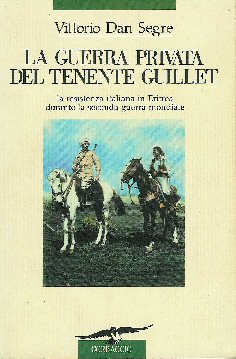
The book by Vittorio Dan Segre entitled “La guerra privata del tenente Guillet. La resistenza italiana in Eritrea durante la seconda guerra mondiale” [The Private War of Tenent Guillet] (Tea, Milano, 1997) is an interesting biography of an Italian legend, military officer and diplomat, written by another eclectic figure, who parted his life between the Israeli diplomatic and intelligence services and the academic career.

The book (in Italian) is about the exceptional life of Amedeo Guillet, a former officer of the Italian Army. Descendant from a noble family from Piedmont, born in Piacenza in 1909, he graduated from the Academy of Infantry and Cavalry of Modena in 1930. An excellent horseman, Guillet was selected for the Italian Olympic equestrian team and was due to compete in the Berlin 1936 Olympics. Instead, he participated to the Italian conquest of Ethiopia in 1935 and volunteered during the Spanish Civil War, returning to East Africa in the aftermath if World War II.

During the war, Viceroy Amedeo, Duke of Aosta, gave Tenant Guillet command of the 2,500 strong Gruppo Bande Amhara, made up of recruits from throughout Italian East Africa. Guillet’s most important battle happened towards the end of January 1941 at Cherù when he decided to attack enemy armored units. At dawn he charged a column of tanks armed only with swords, guns and hand grenades. This was the last cavalry charge the British faced and one of the last in the history of cavalry.

After the Italian surrender in East Africa in 1941, Guillet began a private war against the British, faithful until death to the oath to the House of Savoy, with the nickname of “Devil Commander”. He was famous during the Italian guerrilla war in Ethiopia in 1942 because of his courage and ability to obtain the support of the local population - thanks to his knowledge of Arabic and Islamic civilization - in order to avoid being captured by the British Intelligence. Guillet was finally able to reach neutral Northern Yemen, where he trained soldiers and cavalrymen for the Imam’s army. He finally returned to Italy a few days before the armistice, embarking incognito on a Red Cross ship.

After Italy’s surrender, Guillet was promoted to Major for his war accomplishments and was assigned to the Military Intelligence. In this role, he worked closely with an official of the British services, Vittorio Dan Segre, who later became his close friend and biographer.

Following the war Guillet entered the Italian diplomatic service where he represented Italy in Egypt, Yemen, Jordan, Morocco, and finally as ambassador to India until 1975. In 1971, he was in Morocco during an assassination attempt on the King.

On 4 November 2000, the Italian Armed Forces Day, Guillet was presented with the Knight Grand Cross of the Military Order of Italy (the highest military decoration in Italy) by President Carlo Azeglio Ciampi.

Vittorio Dan Segre, born in Italy in 1922, emigrated to Palestine in 1938. He worked for the British Intelligence during WWII. He met Amedeo Guillet in Naples in 1944, after having read the intelligence files about the “Devil Commander” and the Italian guerrilla in Abyssinia. After a brief period in the diplomatic service of Israel, he pursued the academic career, teaching at the University of Haifa and then at Oxford University, MIT, and Stanford University.

(Marco Davi')

Sunday, February 24, 2008

Emil Kazakov and Bulgarian Geopolitics


The Bulgarian diplomat Emil Kazakov has recently published a book titled The Bulgarian Geopolitics in 20th Century: A National, European and Global View, Faber, 2007, 252 p. (The book is in Bulgarian); Preface by Prof. Beatrice Giblin.
It is an original study of the geopolitical permanencies (perceptions and material factors) that have shaped Bulgarian politics from the end of Ottoman rule in 1878 until the end of the post-communist period in 1997-2000.
The first part of the book is dedicated to the historical and geopolitical conditions that have contributed towards the formation of the individual identity of Bulgarian politics: the three wars in 1913, 1919 and 1947; the Macedonian Question and the formation of a territorial perception of national unity.
The second part investigates the specifics of contemporary Bulgarian politics "inherited" from the national geopolitical pattern. The third part concerns the different perceptions of the Bulgarian geopolitical position and their impact on the decision making process. The final part analyzes the influence of the global geopolitical ideas over Bulgaria's position as a NATO and EU member and defends the need of a pragmatic approach towards the formulation of Bulgarian politics.

Emil Kazakov has a PhD in geopolitics and is an expert in external relations. He was born in Varna, Bulgaria in 1960 and has been posted in Paris and he is currently at the Permanent Mission of Bulgaria to the European Union in Brussels.

Monday, January 28, 2008

Maynard Wayne Glitman, The last battle of the Cold War


Providing a first-hand account of the bureaucratic and public struggles leading to the Intermediate Nuclear Forces Treaty, the author focuses on debates among American negotiators, Europeans and Soviets. This is an important look at policy making and negotiations all the more relevant in an age of nuclear proliferation.
Ambassador Glitman played a central role in US INF policy and negotiations during the last decade of the Cold War. His record provides an invaluable account of the dramatic and pivotal developments in Washington, NATO, and Geneva, culminating in the unprecedented achievement of the INF Treaty in 1987, the first agreement in history to eliminate nuclear weapons. His book is an essential reading for anyone who seeks to learn the behind-the-scenes story of the hard work by dedicated diplomats. Part revealing memoir, part insightful diplomatic history, this is a remarkably thorough book highlighting the role and importance of disarmament and arms control negotiations.

Born in 1933, Mr. Glitman entered the Foreign Service in 1956. From 1956 to 1959, he was an economic officer in the Department of State and then was a fiscal and financial officer. An international relations officer in the Department of State until 1967, he was detailed to the United Nations General Assembly and to the National Security Council. From 1968 to 1973, he was a political officer in Paris. He returned to the Department of State to be Director of the Office of International Trade Policy and subsequently was a Deputy Assistant Secretary of State for International Trade Policy. He was then detailed to the Department of Defense, where he was Deputy Assistant Secretary of Defense for International Security Affairs, 1976 - 1977. From 1977 to 1981, he was deputy chief of mission at the United States Mission to NATO in Brussels. He was then appointed Department of State representative and deputy negotiator to the Intermediate-Range Nuclear Forces Negotiations, with the rank of Ambassador, in Geneva from 1981 to 1984. In 1984 Mr. Glitman was chief U.S. representative at the Mutual and Balanced Force Reduction (MBFR) Talks in Vienna. Since 1985 he has been the chief U.S. negotiator for Intermediate-Range Nuclear Forces in Geneva. He was nominated U.S. Ambassador Extraordinary and Plenipotentiary to Belgium, 1988-1991.

Maynard Wayne Glitman, The last battle of the Cold War: an inside account of negotiating the intermediate range nuclear force treaty, Palgrave Macmillan, New York, 2006.

(Marco Davi')

Friday, January 11, 2008

Rudolf Agstner and the history of Austrian Embassies


The Austrian diplomat Rudolf Agstner, currently Ambassador in Addis Abeba, published several books on the history of Austrian embassies abroad such as for example on the embassies in Switzerland, in the United Kingdom and in Germany. On the embassy in Germany he published "130 Jahre Österreichische Botschaft Berlin. Von der Moltkestrasse zur Stauffenbergstrasse. Handbuch der Vertretungsbehörden von Österreich (-Ungarn) in Deutschland seit 1720" (Philo & Philo Fine Arts, 2003) [130 Years Austrain Embassy in Berlin. From the Moltkestrasse to the Stauffenbergstrasse. Handbook of the Representations of Austria (-Hungary) in Germany since 1720]. The book elaborates the Austro-German relations from a different angle, by narrating the history of the Austrian diplomatic and consular representation to Germany over the last centuries. It stretches from the embassy in the Palais Ratibor in the Moltkerstrasse which dates back to the times of the Habsburg Empire to the opening of the new Austrian embassy in the Stauffenbergstrasse in Berlin in 2001. The author describes the various Austrian embassies in Berlin, Bonn and
East-Berlin, and goes back to the 15 delegations, which were in Germany in the 19th century. He also refers to the times of famous Honorary Consuls such as Rothschild, Oppenheim or lemperer.
Rudolf Agstner is an Austrian diplomat. He entered the Austrian diplomatic service in 1977. He has served at the embassies in Paris, Brussels, Tripoli, Cairo and at the Permanent Representation at the UN in New York. He has also taught at the Institut für Zeitgeschichte [Institute for Contemporary History] of the University of Innsbruck. He has published 11 books and around 100 articles.

Friday, December 28, 2007

Robert Cooper and "The Breaking of Nations"


Robert Cooper, The Breaking of Nations. Order and Chaos in the Twenty-first century, Atlantic Monthly Press, New York, 2003.

Albeit this is not a most recent publication, it nonetheless deserves to be considered for its sweeping interpretation of today’s global predicament. In this small book of essays Robert Cooper argues that two revolutionary forces are transforming international relations: the breakdown of state control over violence, reflected in the growing ability of tiny private groups to wield weapons of mass destruction, and the rise of a stable, peaceful order in Europe that is not based on either the balance of power or the sovereignty of independent states. In this scheme, the Westphalian system of nation-states and power politics is being undermined on both sides: by a postmodern Europe and a premodern world of failed states and post-imperial chaos. Furthermore, Cooper explores how the West should cope with the encroachment of premodern violence. The American approach to such threats is hegemonic. The European Union, meanwhile, aims to expand outward to absorb threatening societies on its periphery. In Cooper’s view, neither approach is sustainable, and he seeks a synthesis that would allow the United States and Europe to confront threats together over the long haul.

Robert Francis Cooper was a British diplomat until 2002 when he assumed the role of Director-General of the Directorate-General E - External Economic Relations, Politico-Military Affairs at the General Secretariat of the Council of the European Union.
Born in 1947, he joined the Diplomatic Service of the Foreign and Commonwealth Office in 1970. As a diplomat, he has worked at various British Embassies abroad, notably those in Tokyo and Bonn. At the Foreign Office, he was Head of the Policy Planning Staff from 1989 to 1993. He was the UK’s Special Representative in Afghanistan until mid-2002. Since 2007 he has been a member of the European Council on Foreign Relations.

In 2004, Cooper was awarded the Orwell Prize for The Breaking of Nations.

(Marco Davi')

Sunday, December 16, 2007

French Diplomat Defarges' s book on geopolitics


The French diplomat Philippe Moreau Defarges has published Introduction à la géopolitique (Collection, Points du Seuil, 2nd ed., 2005). As the title already reveals the aim of the book is to introduce the reader to geopolitical thinking. The author provides clear definitions and historical examples, which demonstrate the importance of geopolitics. Moreau Defarges offers an introduction to the geopolitical dimension of the great international issues such as war, international trade or international organisations. The book outlines the importance of geopolitical reasoning, the close link between spatial and political realities and how the geopolitical reality determines inequalities between states, which cannot be ignored.

Philippe Moreau Defarges, Minister Plenipotentiary, is also the co-director of the RAMSES report at the Institut français des relations internationals (IFRI) and professor at Science-Po. He is the author of several publications on international relations and geopolitical issues. These publications include Relations Internationales, Tome 1: Questions Régionales (Poche, 2003), Relations Internationales, Tome 2: Questions Mondiales (Poche, 2007) and Les Institutions Européennes (Broché, 2005).

Saturday, December 01, 2007

Valija diplomatica – Books published by Spanish Diplomats

Spain has a specific series of books exclusively dedicated to titles published whose author is a Spanish diplomat. The series is called “La valija diplomatica” [diplomatic bag] by Editorial Dossoles of Burgos (http://www.dossoles.es/). The series is directed by Amb. Alonso Álvarez de Toledo and includes some twenty titles written by different Spanish diplomats.
The books vary form International Affairs (Viaje Real a Grecia by Javier Jiménez-Ugarte) to Memoirs (Episodios de un Diplomático by Jaime de Piniés y Rubio), from Novels (La Cumbre by Jorge Fuentes) to Poetry (Rimas en claro. Primera Antología de Poetas Diplomáticos (s.XX)), from Culture (La Magia del Teatro by Enrique Llovet) to history (Las Depuraciones de la Carrera Diplomática Española
(1931-1980) by José Luis Pérez Ruiz).
This series is published under the auspices of the Association of Spanish Diplomats (ADE) which supports it through specific subscriptions of its members.
More titles of books published by Spanish diplomats are also available on the site of the Ministry of Foreign Affairs and Cooperation of Spain (Ministerio de Asuntos Exteriores y de Cooperacción) at the page:
http://www.mae.es/es/MenuPpal/Actualidad/Publicaciones+de+la+D.G.C.E/bibliografia_diplomatica1.htm

Monday, November 19, 2007

Book on Peacebuilding by the Italian diplomat Alberto Cutillo

The Italian Diplomat Alberto Cutillo has published an interesting and original book (in English) on Peacebuilding with the title: “Reviewing Fifteen Years of Peacebuilding. Past, Present and Future of International Assistance to Countries Emerging from Conflicts and Italy's Contribution”.
The book traces the evolution of Peacebuilding activities since the early 1990s and sheds light in those areas thatrequire further attention. In spite of the considerable efforts and resources invested in years of practice,Peacebuilding activities throughout the 1990s were undertaken by a multitude of actors in absence of an overall political strategy. The main challenges of Peacebuilding are therefore not due to lack of knowledge or lessons learned;instead, they are due to the failure to produce a commonly agreed doctrine and to translate it into meaningful guidelines on the ground. The book further argues that although progress is being made, the United Nations system and donor agencies have failed thus far to address satisfactorily three main gaps: political leadership,strategic coordination and a comprehensive mechanism.

Note that a Free Online PDF version of the book is available at: http://www.ssi.unitn.it/working_papers/index.htm

Bibliographic data:
Cutillo Alberto, Reviewing Fifteen Years of Peacebuilding.Past, Present and Future of International Assistance toCountries Emerging from Conflicts and Italy's Contribution,Universita' di Trento, Scuola di Studi Internazionali,Working Paper 01/2007, Trento, 2007, pp.139

Tuesday, November 13, 2007

The European Union and the Western Balkans


Luca Gori, Italian diplomat, is the author of a book on the European Union policies towards the Western Balkans countries in the years 1996 - 2007. Gori who has served at the Italian EU mission in Bruxelles analizes the action taken by the Union and its efforts to integrate the region in the European framework. A very interesting book for anyone who also wants to understand the current situation.


The book is available at: http://www.libreriauniversitaria.it/

Sunday, November 11, 2007

Book on French Diplomat Paul Morand


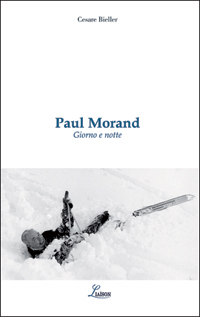
A young Italian diplomat, Cesare Bieller, has recently published a book (in Italian) on the famous French Diplomat Paul Morand.

Paul Morand ( 1888 - 1976) was a French diplomat who excelled in writing novels. His books were noted in the Twenties for their elegant and concise narrative style, and for the author's insightful observations of the many countries he visited. Morand's reputation has been marred by his political stance during the Second War War, when he collaborated with the Vichy Regime. After the war he lived in exile in Switzerland and wrote more profound texts.

Paul Morand's books, be they his travel narratives or his moralistic works, are extraordinarily relevant today. Cesare Bieller reveals to us a few of the many facets of this modern and contradictory writer who loved Italy so much that he named his Memoirs, "Venices". It is a journey into the universe of a writer who, although misunderstood during his lifetime, remains compelling to this day.

Here are the bibliographic data:
Bieller Cesare, Paul Morand. Giorno e notte, Liaison editrice, Courmayeur, 2007, pp.79.
The book is available at http://www.ibs.it

Monday, November 05, 2007

Intercultural Communication between Greeks and Italiana


Fabrizio Lobasso, Italian diplomat and former Consul in Athens, is the author with two researchers from University Ca' Foscari of Venice of an interesting book on intercultural communication between Italians and Greeks.

The book is addressed to professionals working in the fields of business, tourism and culture.

The project has been financed by the Italian Foreign Ministry.